Reported from Toronto, May 2026
Tucked into Toronto's Junction Triangle on a quiet industrial stretch of Cawthra Avenue, Subtext Coffee Roasters doesn't immediately scream for attention. No giant neon sign. No trendy influencer line wrapping around the building. From the outside it almost disappears into the surrounding warehouses and industrial architecture.
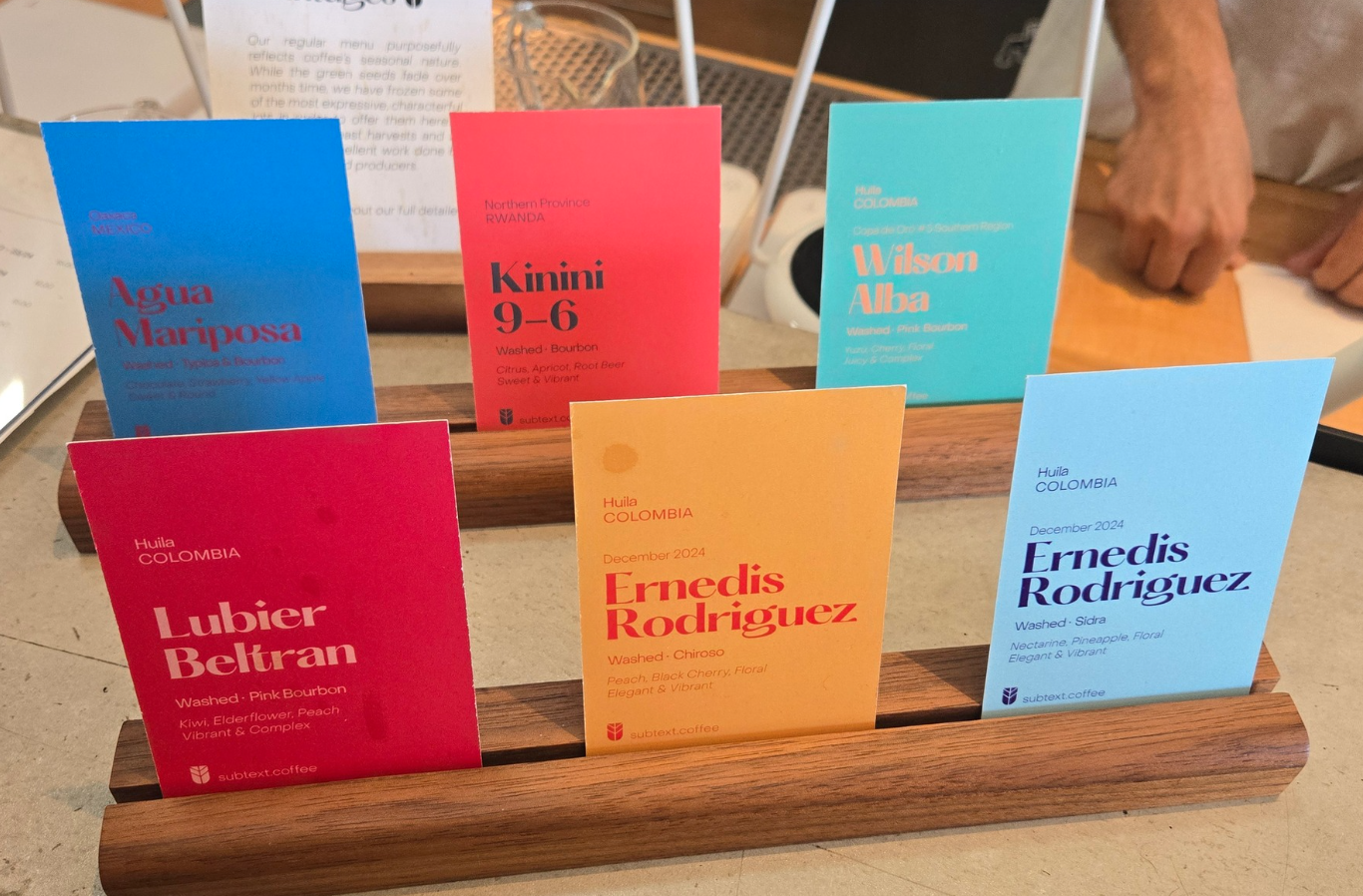
But the second Matt and I stepped inside, we knew we had found the right place for the Connoisseurship Roadshow. The room carried a kind of calm precision to it. Sunlight poured through large windows across minimalist counters and carefully arranged brew stations. The roaster sat visible in the back like part of the experience instead of hidden away behind walls. Cards displaying coffees from Colombia, Mexico and Ethiopia lined the counter with harvest dates, producer names and processing methods printed front and center. Even before ordering, it became obvious this place approached coffee differently. Everything felt intentional.
According to founder Alex Castellani, that's exactly the point.
Coffee as Agriculture
Alex helped launch Subtext in 2020 after years spent working throughout Toronto's specialty coffee scene — including helping build the respected café chain Boxcar Social. Over time, he became increasingly frustrated with how disconnected coffee culture often felt from the actual people producing it. Most consumers know almost nothing about where their coffee comes from beyond broad country labels or vague roast descriptions. Coffee gets renamed, blended together and roasted dark enough that origin character disappears entirely beneath generic "coffee flavor." Consistency becomes the goal instead of expression.
Subtext intentionally pushes against that entire model.
There are no permanent house blends here. No gimmicky names slapped on bags. No dark roasts masking defects or flattening regional nuance. Every bag carries the producer's actual name along with harvest dates, origin details and processing information because, as Alex repeatedly emphasized throughout our conversation, coffee is agriculture first.
Coffee is agriculture first.
The modern coffee industry has historically treated coffee as commodity product instead of agricultural expression. Huge corporations blend beans from multiple regions together to create identical flavor year-round regardless of harvest conditions, soil variation or seasonality. The goal becomes consistency above all else — reliable, predictable and uniform. Subtext rejects that philosophy almost entirely. Instead, the café and micro-roastery embrace seasonality and terroir the same way high-end wine programs might. The menu rotates constantly depending on harvest cycles, regional availability and producer relationships. If you return a month later, the lineup will likely look completely different because coffee is a living agricultural product tied directly to climate, weather and growing conditions around the world.
The Pour-Over at the Center
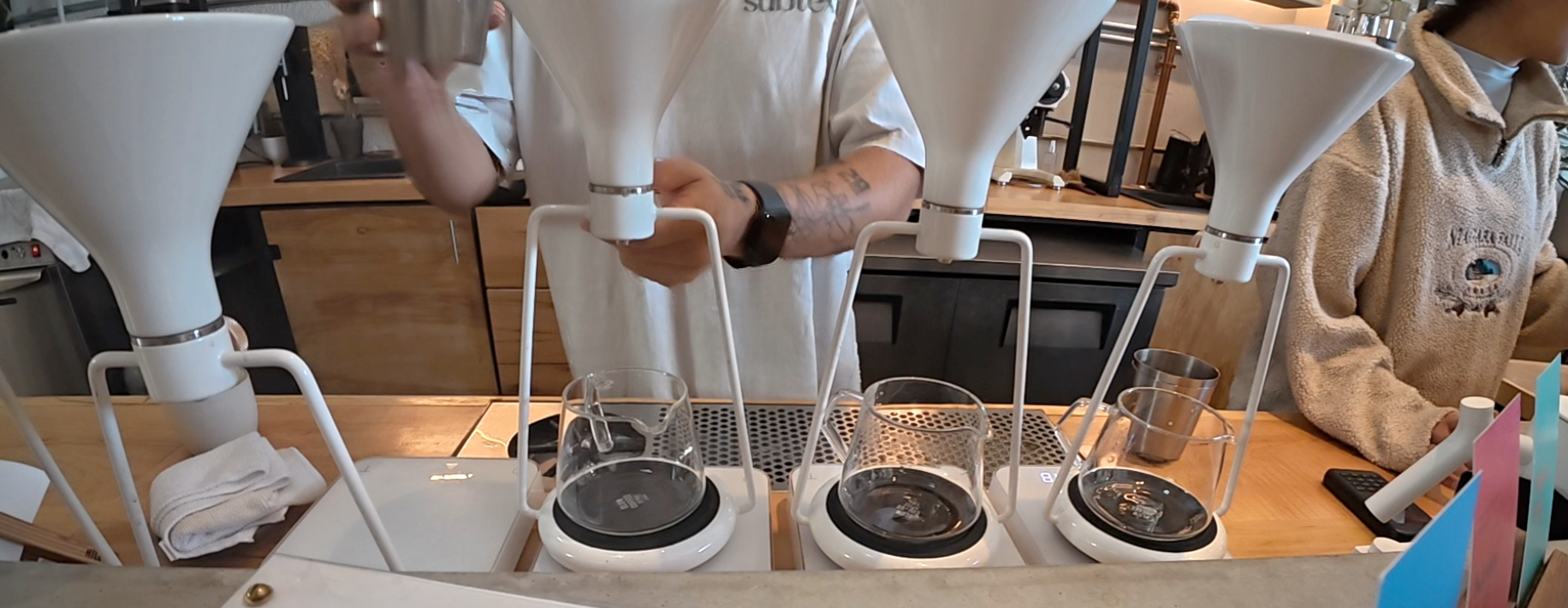
Pour-over brewing sits at the center of that mission. Matt and I immediately noticed that unlike many modern cafés where pour-over feels like an afterthought buried at the bottom of the menu, Subtext places it front and center. Alex explained that was entirely intentional. Pour-over brewing allows the clearest possible expression of terroir, processing and varietal character. The slower extraction combined with paper filtration removes excess oils and sediment resulting in a cleaner cup where subtle flavors become easier to identify. In simpler terms: pour-over lets the coffee speak more honestly.
The process itself also forces intentionality. Water temperature, grind size, pour rate and timing all matter. Every cup gets brewed individually rather than dumped from giant batch brewers sitting for hours. The ritual slows both barista and customer down, creating a more meditative relationship with the drink itself. Watching the team work through their brewing process felt almost surgical in its precision — but never pretentious.
What We Tasted
The coffees themselves completely changed the way Matt and I thought about coffee. The range of flavors coming out of these light roasts was remarkable. Fruit, flowers, herbs, citrus, nuts, chocolate, honey and all kinds of layered complexities shifting across different cups depending on the producer and process.
One Colombian pour-over carried bright yuzu acidity and tropical fruit while another coffee leaned softer with floral sweetness and tea-like clarity. Mexican coffees brought deeper red fruit and chocolate undertones while still maintaining vibrant acidity and freshness. It wasn't pretentious "notes of leather and oak in a forest after rain" nonsense either. The flavors were genuinely there — clear, distinct and easy to notice once somebody slows you down enough to pay attention.
We tasted a washed Pink Bourbon coffee from producer Wilson Alba in Colombia. Bright acidity, floral notes and juicy tropical fruit came through immediately while still maintaining incredible clarity. Alex explained how fermentation timing inside the coffee cherry itself drastically changes flavor development. Leave the fruit intact too long and decomposition flavors begin emerging. Pull it at exactly the right moment and the resulting cup becomes layered and expressive instead of funky or overripe.
That was probably the biggest takeaway from Subtext overall. It introduced us to an entirely new baseline for coffee. Not in a stuck-up way — it was just damn good coffee. The kind of coffee that makes you realize how much complexity and craftsmanship can exist inside something most people drink half-asleep on their commute every morning.
Connoisseurship Without the Gate
One thing Alex pushed back against repeatedly was the idea that connoisseurship needs to become elitist or exclusionary. Specialty coffee often develops a reputation for intimidating jargon and gatekeeping behavior where newcomers feel pressured to "taste correctly" or memorize flavor notes to participate. Subtext approaches things differently. As Alex explained, while taste contains subjectivity, human beings also share enough common biology to build shared sensory language together. Most people can identify citrus when they smell lemon. Most people can recognize sweetness, bitterness or acidity. The point isn't to establish rigid hierarchies of correct taste but to encourage curiosity and deeper observation.
Connoisseurship isn't really about becoming a snob. It's about learning how to pay attention.
That perspective aligned perfectly with what the Connoisseurship Roadshow has been exploring all along. Coffee provides an incredible lens for that because its complexity is almost endless once you start looking closer. Different regions produce dramatically different flavor profiles. Processing methods reshape aroma and texture. Fermentation times, elevation, rainfall and genetics all leave fingerprints behind in the cup.
That level of precision also reminded Matt and me heavily of cannabis cultivation and sensory evaluation — and we spent a good portion of the interview discussing those overlaps directly. Just like coffee, cannabis expresses terroir, cultivation style, genetics and processing through aroma and flavor. Soil composition, climate, microbiology and handling all shape the final experience in subtle but measurable ways.
The Producer at the Center
One of Subtext's strongest philosophies centers around preserving producer identity instead of erasing it beneath branding. Alex criticized how modern coffee culture often removes humanity from the product through blending and homogenization. When multiple farms get collapsed into anonymous house blends, consumers lose connection to the individuals actually growing and processing the coffee.
That same dynamic exists across countless industries. Cannabis brands overshadow growers. Massive wineries obscure vineyard workers. Food supply chains disconnect consumers from farmers entirely. Subtext intentionally fights against that by placing producers directly at the center of the experience. Instead of flashy branding dominating the packaging, producer names and origin details receive the largest typography. The actual farmer becomes the focal point. The coffee becomes less anonymous product and more collaborative agricultural expression.
The sourcing philosophy goes even further. Subtext works heavily with small producers including Indigenous farmers in regions like Oaxaca, Mexico. Many of these producers avoid pesticides and herbicides while growing coffee within dense biodiverse ecosystems. The tradeoff is dramatically lower yields compared to industrial-scale farming — but that inefficiency is also what preserves diversity and regional character.
Somehow despite all that depth, the café itself never felt intimidating. The baristas moved with serious precision while remaining approachable and conversational. Customers asked questions freely. Discussions about fermentation, roast profiles and regional differences flowed naturally throughout the room without anybody acting superior or exclusionary.
Matt and I ended up sitting there far longer than expected — moving through multiple cups side by side, comparing a fruit-forward Colombian against a richer Mexican offering. It felt almost like tasting wine flights except with entirely different textures and flavor structures emerging from each pour-over.
Subtext ultimately represents one of the clearest examples of modern connoisseurship we encountered during the entire Roadshow. Not because the coffee is expensive or exclusive but because the entire operation revolves around preserving nuance, transparency and craftsmanship in a world increasingly optimized for convenience and homogenization.
By the time Matt and I finally stepped back outside into Toronto, it felt like we had attended equal parts coffee tasting, philosophy seminar and agricultural masterclass disguised as a café stop.
Subtext doesn't just serve coffee. It teaches people how to pay attention to it.
Subtext Coffee Roasters subtext.coffee · Map 130 Cawthra Ave, Toronto, ON M6N 3C2